



Throughout the 2026 “Home Is Where You Can Afford It” series, we have examined these two questions:
- Why is housing unaffordable?
- How does the Metro budget fuel gentrification and the affordability crisis?
The answers exposed a deeper truth. Nashville’s housing crisis isn’t just the result of rising rents or supply shortages; those are symptoms. While “more supply” is the mainstream answer to the housing crisis, it is obvious that it isn’t enough. History has shown that when housing is left to the private market, it fails. The decades of public disinvestment have coincided with city growth strategies that contribute to gentrification and rising land values.
We need Metro government to step in where the federal government has abandoned the People in favor of privatized housing policies. The ultra-wealthy class has been enriched, and the vast majority of residents have been priced out. To solve the housing crisis, we have to ensure that public investments create housing solutions with public benefits. Our solution is for Nashville to begin building social housing.
What is social housing?
Social housing is permanently and deeply affordable housing that is available to the public, under community control, and exists outside of the typical real estate market.
Social housing provides two key functions:
- Manages urban land to protect residents from the effects of rising land values and gentrification.
- Uses public resources to lower development costs, creating housing that is affordable across income levels.
There are several models for social housing that cities around the world are using to stabilize housing costs and create permanent affordability. Places in the U.S. that are building versions of this model include Atlanta, Chicago, Seattle, and Montgomery County in Maryland.
We propose that Nashville adopt a social housing model that is:
- Publicly financed using a municipal bond–backed revolving loan fund. This will allow funds to be reused for new housing developments once the debt is repaid. The development essentially pays for itself and can be quickly scaled with new investment.
- Permanently affordable and publicly owned. Based on the financing and ownership structure, the city can keep units affordable in perpetuity. Other subsidies provide at most 30 years of affordability before private owners can raise rents or redevelop.
- Mixed-income. This makes the development financially viable while militating against future harm caused by historical segregation by creating more diverse and integrated communities.
- Protected from speculative real estate markets. A speculative real estate market strategizes on high-risk investments that can be quickly sold for profit, relying on a rapid price appreciation; think house flipping. Permanent public ownership insulates renters from rapid price hikes and displacement common in the private market. At scale, social housing competes with private landlords, raising standards for the entire market.
- Built on public land. Repurpose the land that the city already owns.
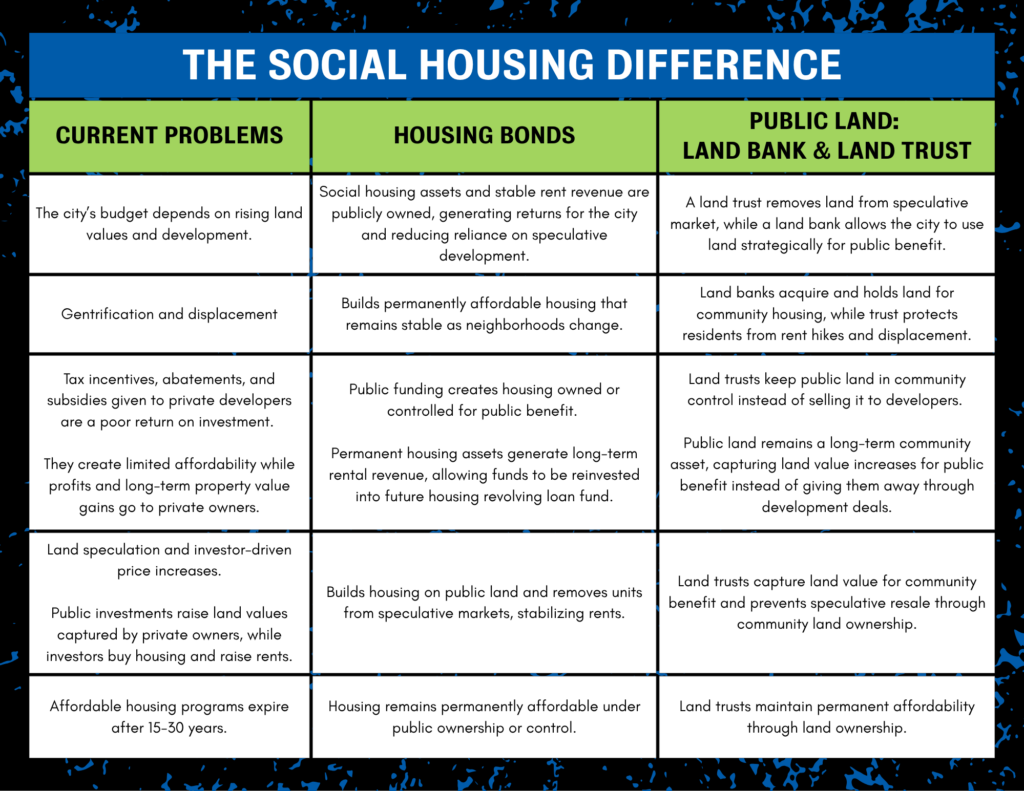
The Difference.
Traditional affordable housing programs rely on subsidizing private developers. Social housing builds public capacity to create housing, ensuring that the public retains ownership or long-term control of the land and housing.
Build the housing Nashvillians need and want.
Our teachers, artists, service workers, nurses, musicians, elders, young adults, and families should be able to afford to live in Nashville. Making it happen requires more than tweaking the current system with small policy adjustments. We need a housing solution and a viable model; we need social housing.
Nashville has proven it can finance large projects with public resources by mobilizing billions of dollars to support private development and tourism. If it can do that, certainly it can also mobilize public resources to build homes for the people who make the city run. Plus, there are other cities already building versions of this model, including Atlanta, Chicago, Seattle, and Montgomery County in Maryland.
Stand Up Nashville has called on the city’s fiscal year 2027 budget to fund a social housing pilot, consisting of:
- 50 mixed-income units comprised of 10 units at 50% AMI, 10 units at 60% AMI, and 30 market rate units.
- Financed through a $20 million municipal bond–backed revolving loan fund. It would cost $1.5 million per year, and once the housing is paid off, the funding will be reinvested into new housing.
- Permanently affordable and publicly owned.
- Built on public land.
A pilot is a modest first step, but it would fundamentally change the city’s approach to housing by prioritizing the People’s stability, permanent affordability, and public capacity. Not private giveaways.
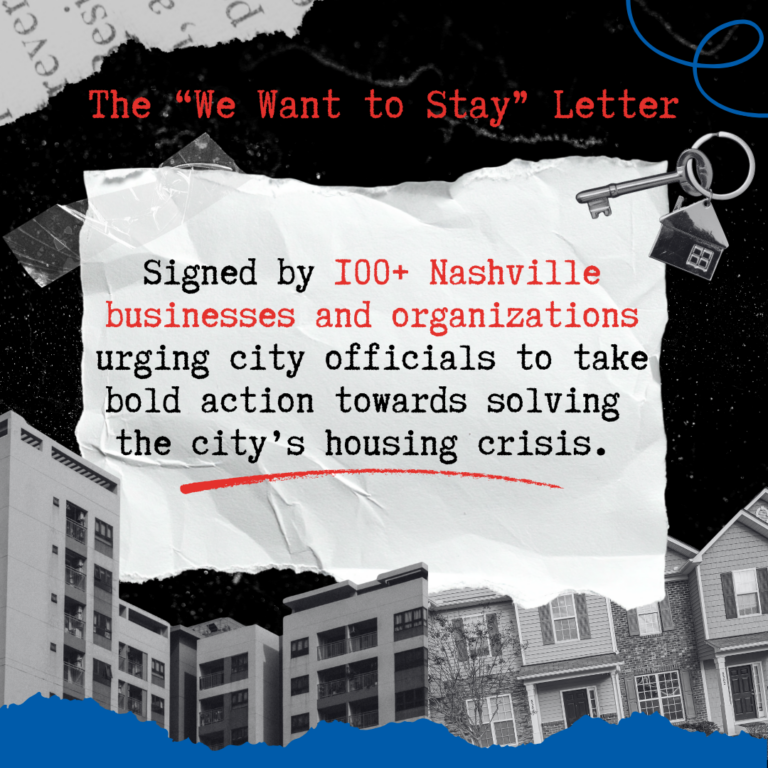
Can we count on you to champion this solution with us? Use our email template to urge Mayor Freddie O’Connell, elected officials, and decision-makers to do what’s right for the people of Nashville. Good news! Our “We Want to Stay” letter from small businesses and organizations that encourage city leadership to take bold, courageous action to solve the housing crisis has received 100+ sign-ons.
We sincerely appreciate your attention and engagement with this series. If something has resonated with you, let us know. We’d love to hear your feedback, ideas, and questions. Lastly, please share “Home Is Where You Can Afford It” with your friends, family, and networks.