



Our previous issue explained how state laws restrict Metro’s ability to raise revenues, which forces the city to pursue strategies that increase how much money existing tax tools bring in, while keeping the tax rate the same. This issue will explain why the city incentivizes development and tourism to boost property and sales tax revenues, and how that drives gentrification.
Gentrification is a term widely used when discussing housing and the changes we see in our communities. But what does it mean? Gentrification is the process of urban areas being transformed in favor of higher priced development, including housing and businesses. It prices out existing residents–especially Black and brown renters, and local small businesses– and displaces them from their neighborhoods and communities.
Nashville’s financial stability has become dependent on gentrification. The same decades-long shift that tied family wealth to rising home values also tied the city budget to luxury developments, tourism, and debt-fueled growth that erodes city services and deepens the affordability crisis. Similar to how homeowners depend on rising home prices to stay afloat, the city’s budget depends on rising land values and tourism to function. That dependency shapes everything.
Development: A budget hooked on rising land values
Urban development, at its core, refers to the construction of new property or the revitalization of existing property in such a way that it raises its property value. Oftentimes, we treat development and gentrification as the same. While in practice the luxury and profit-oriented development in Nashville often contributes to gentrification, the reality is that the city cannot survive without development in some form as long as state rules limit other types of revenue. This is because property taxes make up 57% of Metro’s revenues, and development is the most reliable tool to grow the property tax base.
Two factors make up property taxes: the value of the home and the land it sits on.
Did you know that rising land values—not home improvements—drive the most tax base growth? When land becomes more valuable, home values increase. This causes the tax base to expand even under restrictive state laws. Warning: We’re about to get a bit technical, but stick with us.
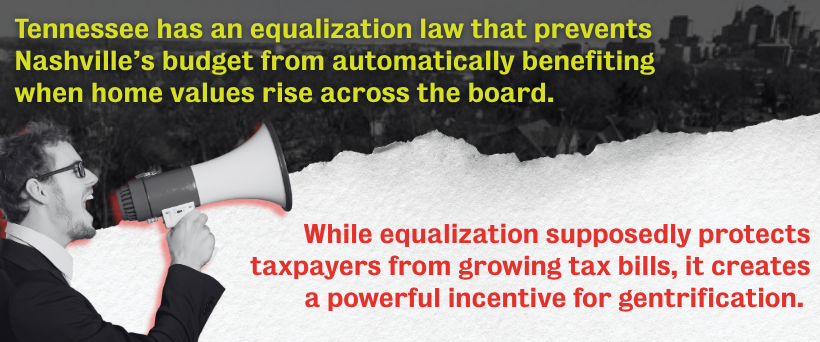
Tennessee has an equalization law that prevents Nashville’s budget from automatically benefiting when home values rise across the board after a countywide reappraisal. Unless Metro Council holds a public vote, which would likely be contentious, the city must automatically lower the tax rate so the total revenue from existing properties stays the same.
- If a home’s value rises faster than the city’s average, its taxes go up.
- If a home’s value rises slower than the city’s average, its tax bill goes down.
- And new development adds taxable value, increasing revenue.
While equalization supposedly protects taxpayers from sudden tax bill hikes, it creates a powerful incentive for gentrification. The city’s tax base grows when land values rise or when new buildings are added, allowing the city to raise more revenue even if the tax rate decreases. While land values rise for multiple reasons, the most common reason is simply that the land becomes more desirable, whether because of location, amenities, private investment, or public improvements. These areas experience rapid land‑value inflation as new construction, investment, and speculation flood in.
Neighborhoods undergoing redevelopment–often Black and working-class neighborhoods–see rising tax bills even if the home or tax rate hasn’t changed, all because the land beneath them has become more valuable. Because of this, some of the wealthiest, established, and most exclusive neighborhoods may actually see their tax bills decrease. While working-class neighborhoods undergoing rapid gentrification take on an increased share of the tax burden for the county. In this way, state revenue and equalization laws make the property tax system even more regressive, benefiting wealthy areas at the expense of working-class taxpayers.
If development raises revenue, why is the budget still broke?
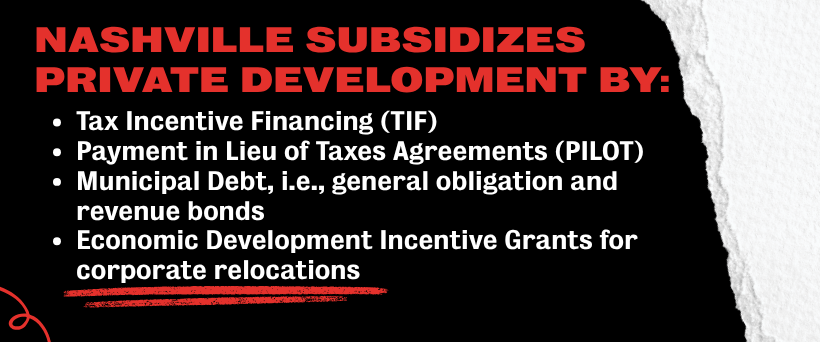
Pause to take a few deep breaths and count to ten. This is where the budget enters a twisted logic. To attract development, the city gives away a chunk of the taxes that development is supposed to generate. It gives up tax revenue now in the hope that development will eventually “pay for itself” in the future. *insert taxpayer blank stare*
Over the years, high-dollar deals have gone to corporations, including AllianceBernstein, Amazon, CoreCivic, Dell Corporation, Hospital Association of America, and Philips Holdings. From 2008 to 2018, property tax giveaways jumped from $9.8M to $34.5M, and Nashville’s debt ballooned faster than any of its peer cities. Even as development booms and land values soar, much of the revenue that should strengthen the city’s finances never makes it into the budget—leaving Nashville struggling to fund basic services.
Why does the city use this model?
Because self‑interest has been packaged as an economic strategy. For years, real estate lobbyists and the politicians who’ve aligned with them have framed tax breaks and incentives as the “normal” way to grow the economy, even though the model drains public resources.
In 2024, Metro’s Tax Incentive and Abatement Study Committee made it clear that incentives with vague “economic growth” goals should be replaced with targeted affordable housing, childcare, and other community benefits. Since day one, SUN has championed the belief that our tax dollars should strengthen workers and neighborhoods—not subsidize corporate employers and developers. Without changing this revenue model, Nashville’s budget will remain hooked on rising land values.
Tourism: A budget hooked on rising prices
Tourism is a major revenue-driving factor for Nashville because it boosts sales-tax collections. Thus, it secures its spot as the second way that gentrification becomes the engine of the city’s budget, instead of affordability.
Think of it this way, property taxes can only go so high before homeowners revolt. In a system where rising home values double as retirement plans, even small tax increases threaten personal wealth. For a homeowner struggling to pay their bills, a small increase can tip the scales in the wrong direction.
Sales taxes help to fill the gap—but the city can’t raise the sales‑tax rate without voter approval. So, Nashville pulls its one reliable lever: tourism. Local tourism boosters argue that tourism grows the local economy and reduces the taxes Nashvillians pay. This argument ignores the costs of tourism: low wages, high prices, and tax giveaways.
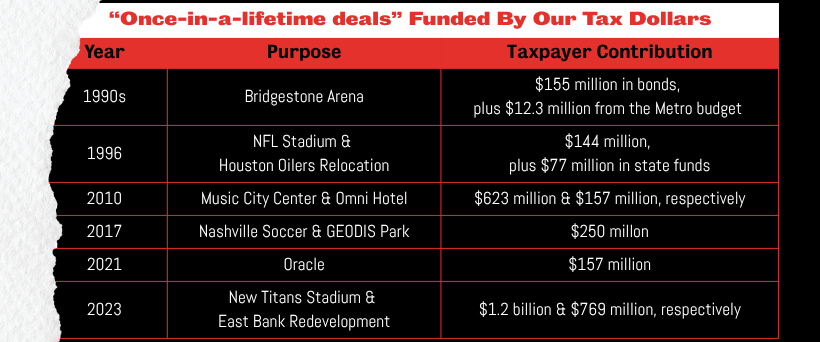
To be clear, tourists should pay for the public services they use. But a tourism‑driven revenue strategy requires enormous ongoing public investment to keep Nashville competitive. Far too often, increased tourism comes at the cost of funds that could and should benefit schools, housing, and neighborhood infrastructure.
Recent examples of projects that Nashvillians paid for, but cater to tourism:
- New Titans Stadium. Can you afford Super Bowl tickets?
- Expanding the police budget required to patrol downtown.
Tourism prices out locals. There are now 9,585 Airbnb listings in Nashville.
- Over 90% of the listings are entire apartments or homes, as opposed to a space in an owner-occupied house.
- Close to 70% are held by owners with multiple rentals.
- Over 4,000 of the rentals are held by hosts who own ten or more properties. Some investors, like Host Extraordinaires and AvantStay Nashville, own hundreds of Airbnbs in the city.
When tourism dominates demand, locals pay more. Residents are in direct competition with visitors for housing, amenities, and public services. Although tourism might be bearable if it created good jobs for Nashvillians, so far it has not. The sobering reality is that the service jobs that support tourism rarely pay a living wage.
According to the National Community Reinvestment Coalition, Nashville ranked as the most gentrified city in the nation from 2010 to 2020. This is no surprise given what we’ve seen from our housing history, tax structure, and development incentives. The financial well-being of the city and many property owners is structurally tied to the very forces that drive gentrification and make housing less affordable.
Nashville is what scholars call a real estate state: a city run by and for the interests of real estate, including its values, needs, and priorities. Homeowners may complain about rising taxes, but they’re trapped in the same system as the city: when land values rise, their wealth rises, too. Tourism eases the tax burden on property owners and boosts corporate profits. For renters who represent 48% of the city’s population and gain none of the wealth from rising land values, tourism makes daily life more unaffordable. They face higher rents, higher fees, and higher barriers to stability in a system that rewards property owners and punishes everyone else.
This all proves Nashville’s affordable housing crisis is a result of a broken housing system and a dysfunctional public budget. Next time, we’ll get into an even bigger question. What’s the alternative, and how do we build it together?
Lastly, have you shared our “We Want to Stay” letter with your network of business owners and nonprofit organizations? It is a unified statement urging Mayor Freddie O’Connell to take bold action to secure housing solutions through leveraging public land and bonds for the people. The housing crisis is too serious, too crucial, and too time sensitive for us not to take action. Please stand with us.