



Every day, residents across the city feel the weight of Nashville’s housing crisis. The problem for the everyday person isn’t that we don’t have housing. We actually have a lot of housing. Every few weeks, there’s another wooded area, former “you name it” building, or a plot of land that is being razed to become the newest build site for housing that misses the mark on affordability. The problem is that existing housing, as well as in-progress housing, doesn’t meet the needs and realities of the people who live here. We need jobs that pay wages that meet the cost of living, and the reality is that housing costs an arm and a leg.
This “Home Is Where You Can Afford It” series will explain why Nashville must use public land and public money—our city’s full fiscal power—to finally bring down the cost of housing for all Nashvillians. We’ll ask the questions you’ve been asking, as well as some you haven’t thought of.
- Why is housing in Nashville unaffordable?
- How does Nashville’s budget fuel gentrification and the affordability crisis?
- What’s the alternative, and how do we build it together?
As we progress through the weeks, we’ll discuss the issues in detail to build your knowledge and understanding. By the end, you’ll clearly see the necessity for a new model for housing and public land.
The Housing Supply
To meet housing needs by 2035, Nashville requires 90,000 more units, including 20,000 affordable ones. This necessitates over 7,000 market rate and 2,000 affordable units annually. Metro’s 2025 Unified Housing Strategy aims for this goal, but major funding for new strategies is yet to come. Even with the Barnes Affordable Housing Trust Fund, affordable housing growth is insufficient. The fund, created in 2013, helps nonprofits build affordable housing. However, Metro projects the Barnes Fund will create or preserve only 650-750 affordable units yearly—well below the 2,000 target—even if fully funded at $30 million, which it hasn’t been for the last two years. At this rate, the 20,000 affordable unit goal will not be met by 2035.
The current budget season is the opportunity for the mayor to choose to either make a major investment into the UHS, or to continue our current trajectory. 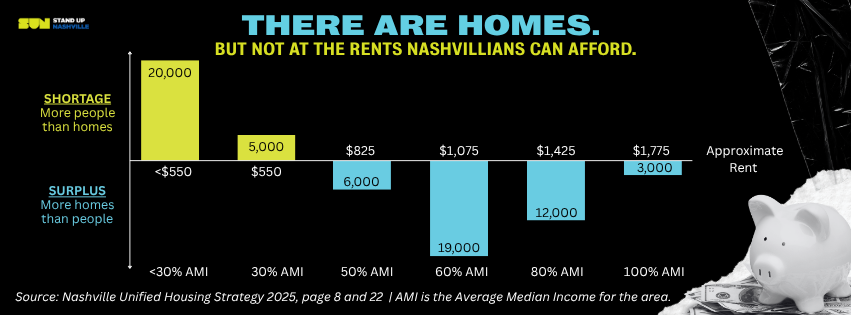
Beyond supply, another contributing factor to the housing crisis is the rising land values caused by public investments and private speculation, which increase the cost pressures for renters and homeowners. On top of this, low wages in the county aren’t on par with the cost of living. All three of these factors accelerate displacement caused by gentrification. That’s why we need solutions that are more expansive than what the city is currently pursuing. Done right, Metro could address housing needs, create pathways out of poverty by building housing with union apprenticeships, and reduce utility costs by improving energy efficiency. Nashville deserves this kind of holistic approach, which addresses affordability, workforce development, and climate resiliency.
No More Business As Usual
SUN recognizes that the solutions to the housing crisis aren’t based on one person, one government department, one private builder, or one non-profit. Yet, that doesn’t absolve the city’s responsibility to steward public policy, public land, and budget funding to make it happen. We’ve conducted the research, hosted deep listening sessions and opportunities to engage community members, and championed housing, good jobs, and more through intentional, innovative, and impactful ways.
For us, the choice is obvious and necessary. The mayor must demonstrate that the city is committed to applying major investments to fulfill key strategies within the UHS. We’re talking fulfillment that:
- Leverages public land for affordable housing
- Establishes dedicated, recurring funding for affordable housing
- Enables affordable housing production that can quickly scale
Addressing these issues is the only way to address long-term affordability and housing production. Business as usual hasn’t done us any favors in getting the change we needed 10 years ago, or that we desperately need now. We’re proposing a different housing model with proven benefits across the country.
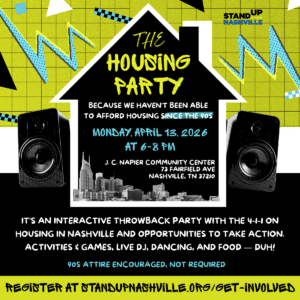
One last thing, we’re hosting The Housing Party, an interactive 90s-themed house party! The throwback jam will feature activities and games centered on all things housing, including ways to take action. Get your dance on with music from a live DJ, and enjoy good food. Rock your 90s attire or don’t—just be there!
🎉 The Housing Party – Monday, April 13, 2026, from 6-8 pm
📍 J.C. Napier Community Center, 73 Fairfield Ave, Nashville, TN 37210